


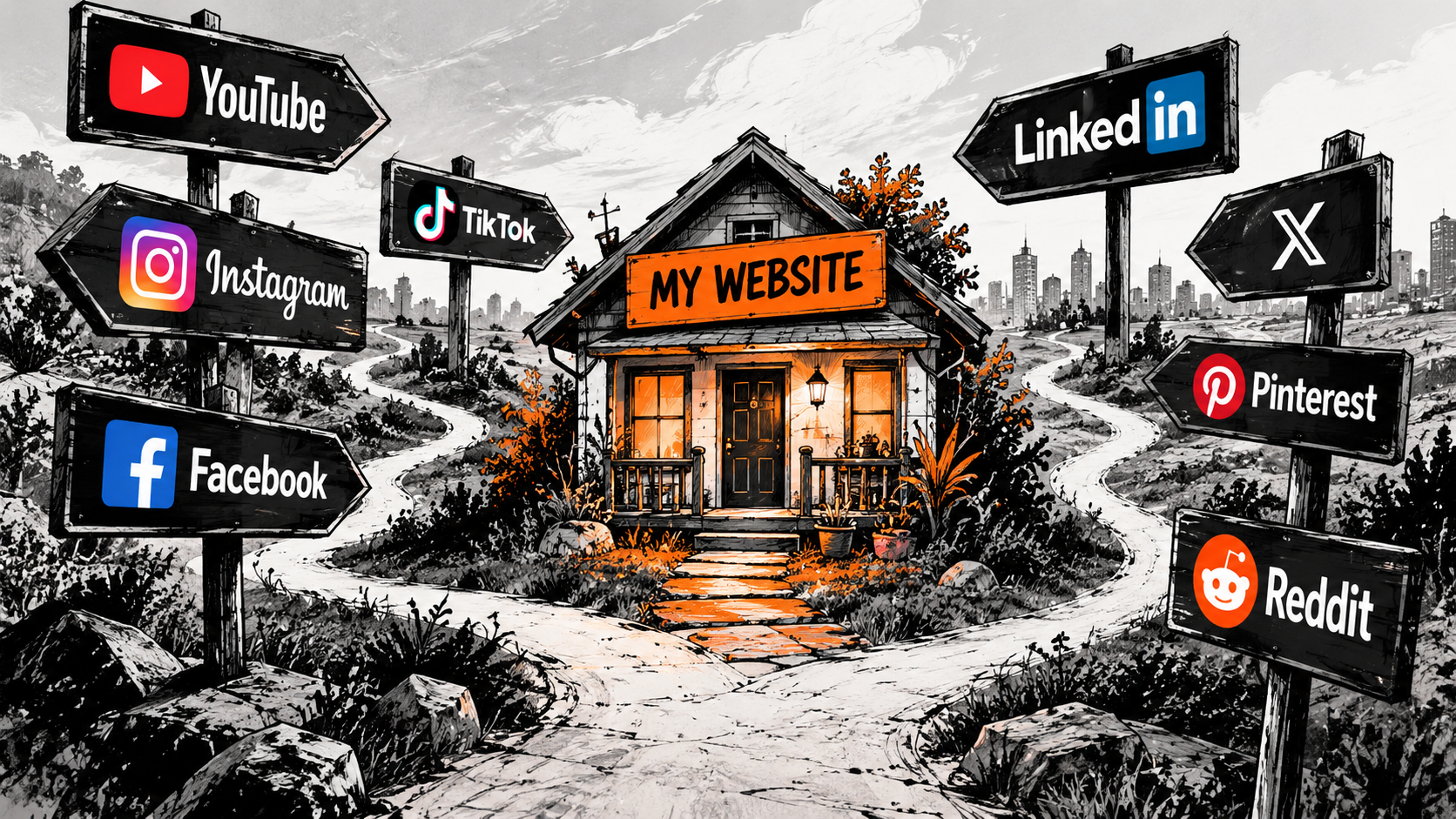
Why build a personal website when social media already does so much?
We already have Facebook, Instagram, LinkedIn, YouTube, and countless other platforms.
They are easy to use and often free.
So why would anyone bother building their own personal website?
A personal website gives you one central place for your work. You control its structure, content, and direction. Social media offers reach and convenience. Your own website adds continuity, search visibility, and a lasting online home. It can connect your articles, videos, projects, and ideas under one address.
Before answering further, we should admit something important.
A personal website is not automatically better than social media.
It takes work. It may cost money. Nobody visits automatically.
A new website can sit online for months without meaningful traffic.
Meanwhile, social platforms already have millions of active users.
That is the strongest argument against building your own website.
And it is a very good argument.
What Are the Disadvantages of a Personal Website?
Owning a website does not magically create an audience.
Publishing an article does not mean Google will rank it.
Adding an email form does not mean people will subscribe.
A beautiful homepage does not automatically create trust either.
Sometimes, a simple social profile makes much more sense.
Imagine someone who sells handmade candles at local markets.
Instagram might provide everything that person needs.
Photos can show the products.
Messages can handle questions.
Followers can see new designs instantly.
Building a complete website could simply create extra work.
The same applies to many hobbies and small side projects.
There is another uncomfortable fact.
Many personal websites never become important online destinations.
Some receive almost no visitors.
Others slowly become outdated and eventually disappear.
Social platforms solve many of these problems.
They provide hosting, design, security, and publishing tools.
They also make publishing incredibly simple.
Open the app, write something, and press “Post.”
A website asks more from you.
You need a domain, hosting, pages, content, and basic maintenance.
You also need patience.
So, the real question should not be:
“Does everyone need a personal website?”
They don’t.
The better question is:
“Why do so many people still build a personal website?”
That question leads somewhere much more interesting.
Personal Website vs Social Media: Control Matters
Consider what happens when you create an Instagram account.
You create your profile inside someone else’s system.
The platform decides how the page works.
It decides where your links appear.
It decides which formats receive more attention.
It also decides what your followers actually see.
That arrangement can work extremely well.
But your control has clear limits.
Now compare that with your own personal website.
You choose what appears first.
You decide where visitors go next.
You can publish articles, videos, resources, or personal projects.
You can change direction without asking anyone.
That difference sounds small until your online activity grows.
Imagine spending five years building one social media profile.
You create hundreds of posts and attract thousands of followers.
Then the platform changes how it shows your content.
Your posts suddenly reach fewer people.
Your audience may still be there.
The rules for reaching them have changed.
That is one reason people build personal websites.
They want one online place with fewer outside rules.
The website becomes their central online home.
Other platforms can become roads leading toward that home.
That does not make social media useless.
It simply gives social media a different job.
How a Personal Website Connects Your Online Presence
Most people do not use just one online service.
Someone might publish videos on YouTube.
They may share short clips on Instagram.
They could also write LinkedIn posts.
Perhaps they recommend products or run a small business.
Without a central place, those pieces remain scattered.
A personal website can connect them.
One page might introduce the person.
Another might contain useful articles.
A third could list favorite tools or resources.
Visitors can then understand the bigger picture.
That matters more than it first appears.
Suppose you discover someone through a 30-second YouTube Short.
You enjoy the idea and want to learn more.
You visit their profile.
There are dozens of unrelated videos.
You still do not know where to begin.
Now imagine their profile links to a personal website.
The homepage explains their main interests immediately.
It points toward their best articles and useful resources.
Suddenly, those scattered pieces form a clear picture.
That is not really a technical advantage.
It is an organizational advantage.
It also gives visitors a clear starting point.
Why a Personal Blog Can Become a Knowledge Library
Social media usually focuses on what happens now.
A personal blog can work differently.
An article written three years ago can remain useful today.
Another article can build upon that original idea.
Over time, something interesting happens.
The website becomes a record of your thinking.
That can be valuable without a huge audience.
Imagine someone researching unusual weather patterns.
They publish one article about extreme rainfall.
Later, they explore heat records.
Then they interview someone who studies storm photography.
Six months later, those pieces form a small knowledge library.
The individual articles now support each other.
Visitors can explore the subject instead of seeing one isolated post.
This is where personal websites can become surprisingly useful.
They can grow slowly.
They do not need constant excitement.
Each useful article adds another piece to the website.
That gives the site something social feeds often lack.
It develops history.
How Search Traffic Can Help People Discover Your Website
Social media discovery often happens quickly.
Someone scrolls past your post and stops for several seconds.
Search works differently.
People often search because they already want an answer.
Imagine someone typing:
“Are extreme weather events becoming more common?”
They are not casually scrolling.
They are actively looking for information.
A useful article can meet that person at the right moment.
That does not guarantee Google traffic.
Competition can be fierce.
Search engines also change how they rank and display information.
AI search tools are changing online discovery too.
Still, searchable website content has one major advantage.
It can remain discoverable long after publication.
A social post may disappear from attention within days.
A useful article can stay relevant much longer.
That difference helps explain why personal websites remain attractive.
There is no honest promise of traffic here.
A website still needs content people actually want to find.
How a Personal Website Can Build Trust Online
Attention is valuable online.
But attention and understanding are different things.
A viral post might reach 100,000 people.
Most viewers may forget it within minutes.
A website visitor can take a different path.
They may read your About page.
Then they might open two articles.
They could watch a video afterward.
Now they understand more about your thinking.
That creates context.
Context becomes especially useful when trust matters.
This could apply to a consultant.
It could apply to an artist or researcher.
It could also apply to someone building an online business.
Visitors can see more than one isolated claim.
They can explore the person’s work themselves.
That does not automatically create credibility.
Poor content can damage trust just as easily.
A polished website can also contain weak information.
Readers should still question claims and check important sources.
A good website simply gives visitors more material to judge.
That distinction matters.
Why People Enjoy Having Their Own Website
Not every personal website needs a business goal.
Some people simply enjoy creating something that belongs to them.
That reason deserves more attention.
Think about renting and decorating a room.
You can make the rented room comfortable.
But you still work within someone else’s boundaries.
A personal website feels different.
You choose the design.
You choose the subjects.
You choose what stays and what disappears.
You can experiment.
You can change your mind.
You can even leave old ideas visible.
That freedom attracts writers, photographers, hobbyists, and curious people.
Sometimes, the website itself becomes the project.
There is value in that even without thousands of visitors.
Do You Really Own a Personal Website?
People often say:
“You own your website.”
That statement needs an important warning.
You still depend on other companies.
Your registrar manages your domain registration.
Your hosting company keeps the website online.
Search engines influence discovery.
Payment companies may handle transactions.
Email services may deliver your messages.
Complete independence does not really exist online.
Still, there is an important difference.
Those services usually perform separate jobs.
Your whole online identity does not rely on one social platform.
If one service stops working, you can often replace it.
You can move hosting.
You can change email providers.
You can rebuild pages elsewhere.
Your domain can remain your familiar online address.
So website ownership does not mean total independence.
It means reducing your dependence on one platform.
That is a smaller claim.
It is also a more honest one.
Why Personal Websites Matter in the AI Era
AI makes online content easier to create.
That creates both opportunity and noise.
People can now produce polished text very quickly.
Images can appear within seconds.
Videos can also be produced faster than before.
That creates a simple problem.
How do you know who stands behind the content?
A personal website can help answer that question.
That does not make websites automatically trustworthy.
They certainly are not.
A website can still publish poor or misleading information.
Instead, a personal website can provide continuity.
You can see what someone published last month.
You can read what they wrote last year.
You can compare their views across different subjects.
You can see whether their ideas develop over time.
You can also notice when they correct or update older work.
That history becomes part of their online identity.
In an AI-heavy internet, that continuity may become more valuable.
Who Actually Needs a Personal Website?
Nobody needs a personal website simply because websites exist.
For many people, social media remains completely sufficient.
A personal website becomes more useful when you want:
- One central place for your online work.
- More control over your content and presentation.
- Articles that remain available over time.
- A searchable library of ideas and projects.
- A home for several different interests.
- Direct connections with readers or customers.
- An online identity that can grow with you.
The key word is grow.
A personal website does not need a finished purpose immediately.
It can begin with three pages and one article.
Then another question appears.
That question becomes another article.
Perhaps an interview follows.
A new interest might create another section.
The website slowly becomes something you could not fully plan.
That may actually be one of its strongest qualities.
Why Build a Personal Website of Your Own?
The internet gives us countless places to participate.
It gives us fewer places that feel like our own.
Social media provides reach.
Video platforms provide audiences.
Marketplaces provide customers.
Online communities provide conversations.
Those tools can be extremely useful.
But they usually represent separate pieces of your online presence.
A personal website can connect those pieces.
It gives your work one address and one clear starting point.
You still need good content.
You still need patience.
You still need to earn people’s attention and trust.
That is exactly why a personal website can be worth building.
You are not borrowing another profile and calling it your home.
You are building a place that can change as you change.
Start with one page and publish one thing worth finding.